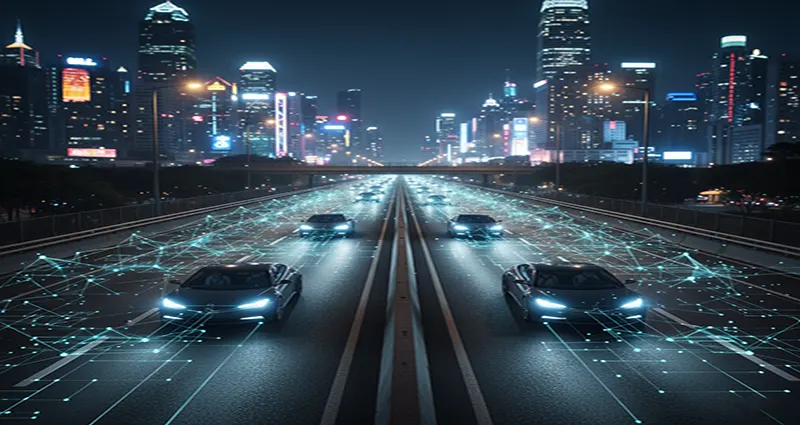
The quest for safer roads and reduced traffic congestion is driving the rapid evolution of automotive technology, with Vehicle-to-Vehicle (V2V) communication technology development standing out as a critical game-changer. V2V technology allows cars to wirelessly exchange essential data with one another, creating a dynamic, real-time awareness of the driving environment far exceeding what a single driver or a single car’s sensors can provide. This connectivity is the foundational layer for truly smart, cooperative transportation systems.
How V2V Technology Works
V2V communication relies primarily on short-range, dedicated wireless channels. The primary standards under development are:
- Dedicated Short Range Communications (DSRC): This older standard uses a version of Wi-Fi ($802.11\text{p}$) to allow vehicles to broadcast basic safety messages (BSMs)—such as position, speed, heading, and braking status—up to 300 meters, ten times per second. This information is anonymous and encrypted for security.
- Cellular Vehicle-to-Everything (C-V2X): This newer, increasingly preferred standard leverages modern cellular networks (4G/5G) for communication. C-V2X offers greater range, higher bandwidth, and lower latency, enabling not just V2V communication but also Vehicle-to-Infrastructure (V2I) and Vehicle-to-Pedestrian (V2P), collectively known as V2X.
Key Developments and Safety Benefits
The development of V2V is centered on providing drivers and automated systems with timely warnings and information to prevent the most common types of accidents.
- Collision Prevention: V2V can alert a driver to an impending collision even if the other vehicle is out of sight, such as around a blind corner or through a line of traffic. Applications include Intersection Movement Assist (preventing red-light running accidents) and Left Turn Assist (warning against unsafe turns into oncoming traffic).
- Cooperative Adaptive Cruise Control (C-ACC): Vehicles can communicate to optimize speed and distance not just based on the car immediately ahead, but based on a chain of vehicles. This enables tighter platooning, increasing road capacity and improving fuel efficiency by reducing air drag.
- Emergency Braking Alerts: If a car several vehicles ahead brakes suddenly, that information is instantly relayed to all following cars. This provides drivers with precious fractions of a second more reaction time than they would get from traditional brake lights, potentially eliminating chain-reaction crashes.
Challenges and the Path Ahead
Despite the profound benefits, the path to widespread V2V adoption faces hurdles, primarily concerning regulatory standardization and security. Governments must choose a unified communication standard (DSRC vs. C-V2X) to ensure interoperability across all vehicle manufacturers. Furthermore, guaranteeing the privacy of data and protecting the system from cyber-attacks are paramount.
As C-V2X gains momentum and is integrated into 5G networks, V2V technology will move beyond simple safety warnings to enable true cooperative driving and facilitate the seamless operation of fully autonomous vehicles. The connected future of transportation is no longer theoretical; it is being actively built on the backbone of V2V communication.