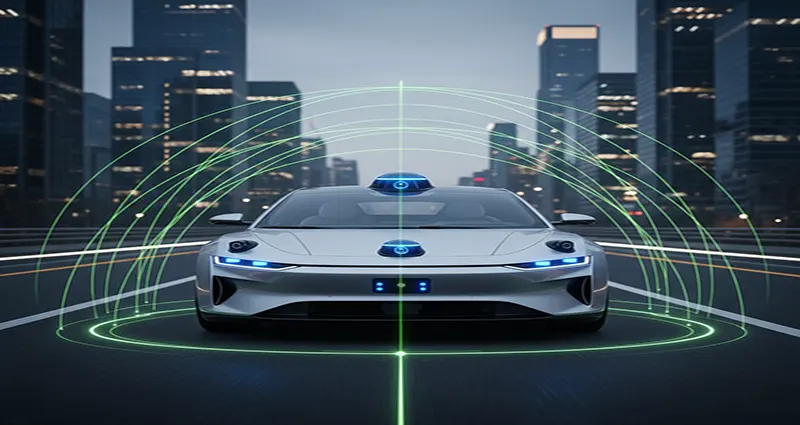
The promise of autonomous driving—vehicles that pilot themselves with minimal or no human intervention—rests entirely on their ability to perceive the world accurately. This capability is delivered by a sophisticated array of sensor technologies that act as the car’s eyes, ears, and sense of distance, directly enabling the advanced safety features that underpin the next generation of road transport.
Key Autonomous Driving Sensor Technologies
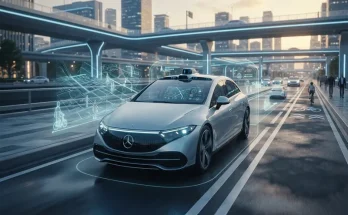
Autonomous vehicles (AVs) rely on a combination of different sensor modalities to build a robust, 360-degree understanding of their environment, a process known as Sensor Fusion.
1. Light Detection and Ranging (LiDAR)
LiDAR systems use laser pulses to measure distances, creating a highly detailed, three-dimensional “point cloud” map of the surroundings.
- Core Function: High-resolution 3D mapping and object shape recognition.
- Safety Contribution: Provides millimeter-precise localization and obstacle detection (pedestrians, small debris, road contours), which is critical for complex urban driving scenarios and avoiding collisions.
- Limitation: Performance can degrade significantly in adverse weather conditions like heavy rain, fog, or snow.
2. Radio Detection and Ranging (Radar)
Radar emits radio waves and measures the return time and frequency shift (Doppler effect) to determine the distance, velocity, and angle of objects.
- Core Function: Long-range detection, speed measurement, and all-weather performance.
- Safety Contribution: Essential for Adaptive Cruise Control (ACC) and Automatic Emergency Braking (AEB) due to its accurate velocity measurement and reliability in poor visibility (fog, rain, darkness). Modern 4D Imaging Radar is improving resolution to capture elevation, making it even safer.
- Limitation: Lower resolution than LiDAR, making it less adept at recognizing fine details or object shapes.
3. Cameras (Visual Sensors)
Cameras capture visual data, providing high-resolution color images of the environment.
- Core Function: Object classification, traffic sign recognition, lane marking detection, and color/texture information.
- Safety Contribution: Works with Artificial Intelligence (AI) to perform critical tasks like identifying traffic lights, reading speed limits, and enabling Lane Keeping Assistance (LKA). They are vital for contextual understanding, much like human sight.
- Limitation: Highly dependent on light conditions (poor performance in dark or glare) and easily obscured by dirt, snow, or fog.
4. Ultrasonic Sensors
These sensors emit high-frequency sound waves and measure the time it takes for the echo to return.
- Core Function: Short-range detection and proximity sensing.
- Safety Contribution: Primarily used for low-speed maneuvers like Automated Parking and Blind Spot Warning (BSW) systems, where centimeter-level accuracy for close objects is necessary.
- Limitation: Very limited range (typically less than 5 meters).
Sensor-Enabled Safety Features
The data from this sensory suite is continuously fed into the vehicle’s central computing system, enabling an array of Advanced Driver Assistance Systems (ADAS) and, ultimately, full autonomous operation. These systems are the core safety benefits of the technology:
| Safety Feature | Primary Sensor Dependency | Safety Function |
| Automatic Emergency Braking (AEB) | Radar and Camera/LiDAR | Automatically applies brakes to mitigate or prevent a collision if the driver fails to react to an imminent threat. |
| Adaptive Cruise Control (ACC) | Radar | Maintains a safe, pre-set following distance and speed relative to the vehicle ahead, even in stop-and-go traffic. |
| Lane Keeping Assistance (LKA) | Camera | Uses image processing to identify lane markings and gently steers the vehicle back into the lane if it begins to drift unintentionally. |
| Blind Spot Monitoring (BSM) | Radar and Ultrasonic | Detects vehicles in the driver’s blind spot and issues a visual or audible warning. |
| Collision Avoidance/Warning | All sensors (Fusion) | Provides warnings or actively steers/brakes to prevent lateral and frontal collisions with vehicles, pedestrians, and cyclists. |
The Crucial Role of Sensor Fusion
No single sensor technology can reliably provide a complete picture of the environment under all possible driving conditions. For example, a camera might be blinded by a bright sunset, while LiDAR might struggle in a blizzard, and radar lacks the resolution for object classification.
Sensor fusion is the process where powerful onboard computers take the raw data from all these systems (LiDAR, Radar, Cameras, etc.) and combine it in real-time. This redundancy and cross-checking lead to a more reliable, accurate, and complete perception of the world than any single sensor could achieve alone. This integrated, multi-layered approach is the ultimate safety feature of autonomous driving, ensuring the vehicle can make sound decisions even when one sensory input is compromised.
The Future of Sensor Safety
Innovation continues to focus on enhancing sensor performance and improving resilience to weather and diverse lighting. The development of cheaper, smaller solid-state LiDAR units and high-resolution 4D imaging radar are pushing the envelope. Ultimately, the goal is to create a safety record significantly better than that of human drivers, dramatically reducing the 94% of crashes currently attributed to human error.