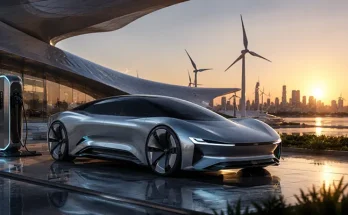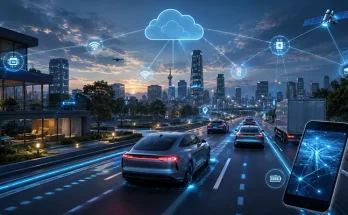


The vision of fully self-driving cars—known as Level 5 autonomy—is being brought closer to reality by relentless next-generation autonomous driving technology advancements. Moving beyond today’s Level 2 driver assistance systems, the future hinges on breakthroughs in sensing, communication, and artificial intelligence, all working in concert to create vehicles that are safer, smarter, and seamlessly integrated into the world around them.
Smarter Sensors: Beyond Sight
The immediate future of autonomy is defined by radically improved perception systems that overcome the limitations of current technology.
- Next-Gen LiDAR and Terahertz Vision: While current Light Detection and Ranging (LiDAR) provides excellent 3D mapping, new Solid-State LiDAR is driving down costs and improving reliability. An even more significant advancement is the emergence of Terahertz (THz) Vision Sensors. This technology offers resolution up to twenty times higher than conventional radar and promises all-weather, long-range perception, effectively mitigating the common issues of fog, heavy rain, or glare that challenge existing sensor suites.
- 4D Imaging Radar: Modern radar is evolving into a high-resolution 4D system that can capture the elevation (height) of objects in addition to their range, speed, and azimuth. This leap in detail makes radar a highly effective, redundant sensor, crucial for differentiating between road debris and an overhead sign.
- Hyper-Fusion Perception: The key to L4 and L5 autonomy is the sophisticated fusion of data from multiple sensor types (cameras, radar, LiDAR). Advanced Sensor Fusion algorithms, powered by deep learning, enable the vehicle to build a unified, high-fidelity, 360-degree model of the environment that is far more reliable than any single sensor input.
The Rise of Cognitive AI and Computing
The “brain” of the next-generation autonomous vehicle must process astronomical amounts of data in real-time to make split-second, human-like decisions.
- Deep Learning and Neural Networks: AI is moving from simple object recognition to complex scenario prediction. Advanced neural networks are trained on petabytes of real-world and simulated data to not only identify objects but predict the future behavior of cyclists, pedestrians, and other vehicles under complex, uncertain conditions.
- Edge Computing and Custom Silicon: Processing all this data locally requires immense computing power with ultra-low latency. The adoption of custom-designed, automotive-grade AI inference chips and Edge Computing—processing data right where it’s collected—is essential for the instantaneous response times needed for high-speed, full autonomy.
Connectivity and Infrastructure Integration
Full autonomy requires cars to operate as nodes in a wider intelligent transportation network.
- Vehicle-to-Everything (V2X) Communication: Enhanced by high-speed 5G connectivity, V2X allows autonomous vehicles to communicate with each other (V2V), roadside infrastructure (V2I) like smart traffic lights, and even pedestrians (V2P). This enables vehicles to “see” around corners, anticipate hazards obscured by traffic, and optimize traffic flow collectively, dramatically increasing safety and efficiency.
- High-Definition (HD) Mapping: Next-generation AVs rely on continuously updated, centimeter-level HD Maps that contain detailed lane geometry, sign placement, and roadside features. Vehicles use this map data for precise localization and path planning, ensuring they know exactly where they are, even when sensor visibility is temporarily compromised.
These technological pillars are collectively paving the way for Level 4 (High Automation) services, such as driverless robotaxis in geo-fenced areas, and the ultimate goal of Level 5 (Full Automation), where the vehicle can drive itself anywhere, anytime, under any conditions.