

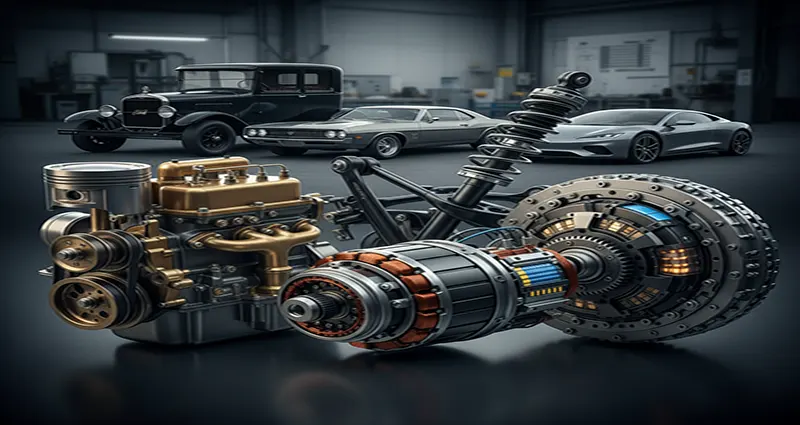
The car is arguably the most transformative invention of the modern era, reshaping cities, economies, and personal freedom. This revolution wasn’t driven by a single invention, but by a continuous stream of amazing car engineering innovations that fundamentally changed how we live, work, and travel. From making vehicles affordable to making them incredibly safe, these breakthroughs define automotive history.
The Innovations of Accessibility and Power
Early innovations focused on making the car practical, affordable, and powerful, transitioning it from a luxury curiosity to a democratic necessity.
- The Internal Combustion Engine (ICE): While developed in the mid-19th century, its refinement by engineers like Karl Benz in 1886 led to the first true gasoline-powered automobile. The ICE provided a compact, energy-dense power source that paved the way for modern transportation.
- The Assembly Line: Henry Ford’s introduction of the moving assembly line in 1913 was a manufacturing, not just an engineering, marvel. By standardizing parts and optimizing workflow, the process drastically cut production time and reduced the price of the Model T, making car ownership accessible to the masses.This innovation reshaped global industry and labor.
- The Electric Starter: Before the electric starter, beginning a car’s engine required a dangerous, physical effort with a hand crank. Charles Kettering’s invention, first commercialized in the 1912 Cadillac, rendered the hand crank obsolete. This single engineering achievement made driving easier and safer, particularly for women, and accelerated the car’s adoption by the general public.
The Life-Saving Safety Revolution
Perhaps the most impactful innovations are those focused on safety, which moved the car from a risky machine to one of the most protected environments on the road.
- The Three-Point Seat Belt: Invented by Volvo engineer Nils Bohlin in 1959, and shared patent-free with the world, the three-point belt is credited with saving millions of lives. By securing both the upper and lower body, it dramatically reduces collision impact forces. It remains the most basic and effective safety device in every modern car.
- Anti-lock Braking System (ABS): Initially developed for aircraft, ABS became widespread in cars in the 1970s and 80s. This system prevents the wheels from locking up under heavy braking, allowing the driver to maintain steering control while stopping. ABS marked the beginning of active safety features, helping drivers avoid accidents rather than just surviving them.
- Crumple Zones: Pioneered by Béla Barényi at Mercedes-Benz, the concept of the crumple zone involves engineering the car’s body to deliberately deform and absorb kinetic energy during a crash. This protects the rigid safety cell surrounding the occupants, fundamentally shifting collision strategy from brute strength to controlled energy absorption.
Modern Engineering and the Future
More recently, electronic and software-driven systems have taken the lead in automotive advancement.
- Electronic Stability Control (ESC): Developed in the 1990s, ESC uses sensors to detect when a car is skidding or losing control and automatically applies individual brakes to restore stability. It’s an essential system that drastically reduced single-vehicle accidents and rollovers, becoming mandatory in many countries.
- The Hybrid Powertrain: While early concepts existed, Toyota’s mass production of the Prius in the late 1990s introduced the efficient parallel hybrid system to the world. It showed that combining gasoline and electric power could deliver high fuel efficiency without compromising range, paving the way for today’s rapid shift toward electric vehicles (EVs) and sustainable mobility.
These engineering achievements are a testament to the fact that the greatest car innovations aren’t always about speed, but about making the world a safer, more efficient, and more connected place.