1. The Scaling Bottleneck
While passenger electric vehicles have achieved impressive fast-charging speeds, the heavy-duty commercial sector—comprising long-haul semi-trucks, transit buses, and industrial machinery—faces a massive energy replenishment hurdle. Traditional direct current (DC) fast chargers cannot power massive battery packs quickly enough to prevent devastating operational downtime.
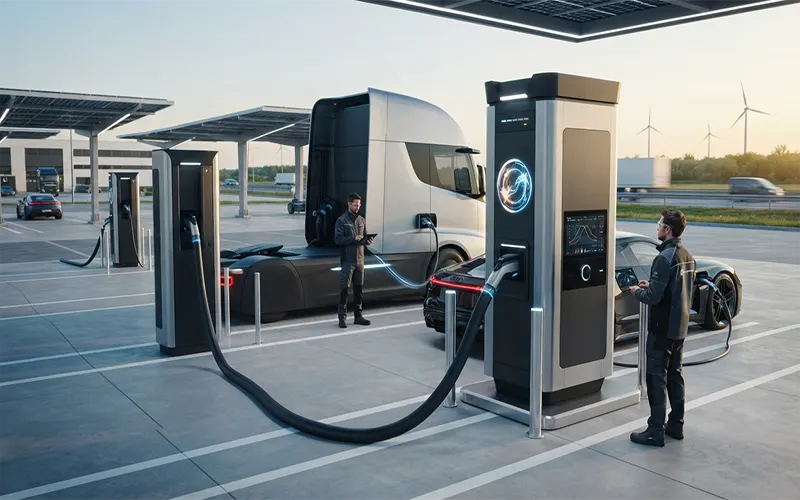
Enter the Megawatt Charging System (MCS), the ultimate technological leap designed to deliver unprecedented energy output. Driven by recent global standardization milestones, liquid-cooled hardware innovations, and smart grid integration, megawatt-level charging is permanently transforming long-haul logistics and heavy transport.
2. The Engineering Anatomy of Megawatt Charging
To grasp the magnitude of MCS, one must look closely at the electrical thresholds required to move heavy commercial freight electrically:
- Breaking Down the Numbers: While standard DC fast chargers max out around 350 kW, true megawatt architecture scales power delivery from 1 MW to 3.75 MW (operating up to 1,500 volts and 3,000 amps DC).
- Thermal Management Breakthroughs: Delivering thousands of amps generates immense resistive heat. Advanced systems rely on sophisticated liquid-cooled cables, high-capacity connectors, and active vehicle-side thermal loops to keep material temperatures well within safety limits.
- Global Standardization: Regulatory frameworks—such as the official release of the IEC TS 63379 standard and aligned SAE J3271 specifications—have unified global engineering requirements. Utilizing ISO 15118-20 for secure communication protocols ensures cross-manufacturer interoperability from day one.
3. Real-World Deployment: Heavy-Duty Fleets and Freight Corridors
The primary promise of megawatt charging is its seamless alignment with rigorous commercial logistics schedules:
- Aligning with Driver Regulations: Commercial truck drivers are legally mandated to take rest breaks (such as a 45-minute pause after 4.5 hours of driving in many jurisdictions). An MCS session can restore a heavy electric truck’s battery from 20% to 80% within roughly 15 to 30 minutes, fitting natively into required rest periods without extending transit times.
- Corridor Infrastructure Rollouts: Major freight corridors across Europe and North America are actively deploying multi-site megawatt hubs. Government-backed initiatives and private logistics consortia (such as multi-megawatt depot expansions) are building dense webs of high-power charging stations along vital trade routes.
- Spillover into Specialized Sectors: Beyond logistics trucks, the underlying ultra-high-power architectures are expanding into aviation (e.g., e-VTOL and electric commuter aircraft) and maritime shipping (e.g., electric ferries and tugboats).
4. Solving the Grid Crisis: Battery-Buffered Systems and Smart Energy
Pulling 1 megawatt or more directly from local utility lines creates massive stress on regional electrical grids, often resulting in prohibitive connection costs and multi-year permitting delays.
- The Rise of Energy Storage Buffering: To bypass grid bottlenecks, infrastructure operators increasingly pair MCS stations with on-site Battery Energy Storage Systems (BESS). These stationary banks store energy slowly and steadily from the grid over time, then discharge it at megawatt speeds during vehicle connection.
- Intelligent Load Management: Advanced digital platforms optimize site operations by integrating local renewable sources (like solar canopies), capitalizing on time-of-use energy arbitrage, and smoothing peak demand spikes.
- Microgrid Integration: Industrial depots function more like independent microgrids, ensuring grid-forming capabilities and uninterrupted high-power availability even in remote logistics locations.
5. Overcoming Hardware and Economic Hurdles
Deploying and maintaining megawatt-scale equipment demands overcoming rigorous physical and financial thresholds:
- Component Durability: Plugs and cables must withstand thousands of high-amperage connection cycles under harsh weather conditions without mechanical wear, pitting, or electrical arcing. Ruggedized materials and automated sensor diagnostics ensure long-term reliability.
- Capital Expenditure and ROI: While initial capital expenditures for megawatt installations are substantial, fleet operators achieve rapid return on investment (ROI) through maximized vehicle uptime, lower operational energy costs, and reduced reliance on diesel fuel.
- Safety Protocols: Advanced digital handshakes, automated isolation barriers, and continuous temperature monitoring safeguard workers and drivers against high-voltage faults during every charging event.
Megawatt electric vehicle charging technology has successfully crossed the barrier from theoretical engineering blueprints to commercial reality. By unifying global standards, deploying battery-buffered grid solutions, and matching the operational rhythms of heavy transport, MCS is eliminating the final structural barrier to global freight electrification. As deployment accelerates, megawatt charging will stand as a core pillar of modern sustainable logistics.