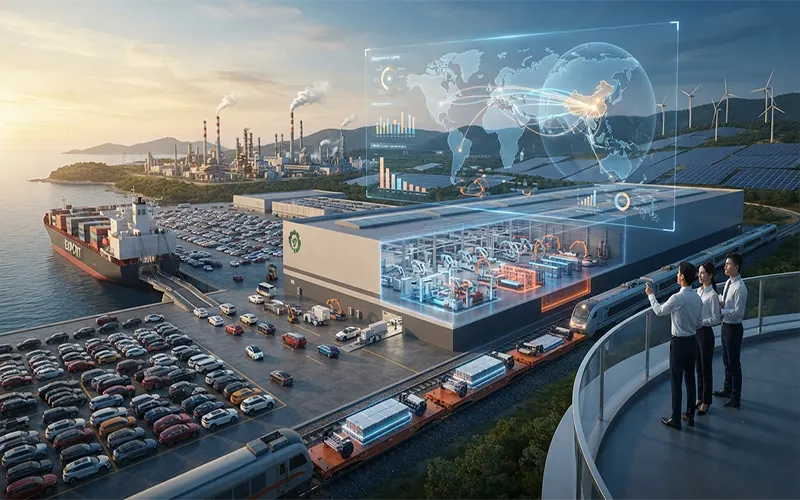
The global transition to electric vehicles (EVs) is fundamentally tethered to a single industrial powerhouse: China. This absolute dominance is not an overnight accident, nor is it merely the product of cheap labor. Rather, it is the result of a multi-decade, state-supported masterclass in resource control, vertical integration, and unmatched manufacturing scale.
Understanding how China captured nearly every tier of the modern automotive ecosystem reveals structural realities that legacy manufacturing hubs are scrambling to replicate.
Core Pillars of China’s Supply Chain Dominance
China’s leadership across the EV value chain rests on three essential, deeply entrenched structural pillars:
1. Mineral Refining and Critical Material Monopolies
Long before mass-market electric cars caught on globally, China secured early dominance over the physical building blocks of the energy transition.
- Upstream Processing Control: While raw minerals like lithium, cobalt, nickel, and rare earth elements are mined across various continents, a staggering percentage of their chemical processing and refining occurs inside Chinese industrial corridors.
- Refining Dominance: China refines a vast majority of the world’s battery-grade graphite, lithium, and cobalt. By mastering complex pyrometallurgical and hydrometallurgical refining processes, Chinese enterprises created a severe bottleneck that competitors cannot easily bypass.
2. Vertical Integration and Battery Cell Hegemony
At the heart of every EV lies the battery pack, which historically accounted for up to 40% of a vehicle’s total cost. Domestic giants like CATL and BYD systematically restructured cell manufacturing economics.
- Unmatched Scale and Cost Efficiency: Through massive production volumes and hyper-optimized cell-to-pack (CTP) architectures, Chinese battery makers achieved structural cost advantages that Western competitors struggle to match.
- Ecosystem Proximity: Cathode and anode material manufacturers, separator plants, and electrolyte suppliers cluster within tightly integrated regional industrial hubs, slashing logistics overhead and accelerating innovation cycles.
3. State-Backed Industrial Planning and Infrastructure Synergy
China’s dominance was engineered through coordinated, long-term state planning rather than purely organic market forces.
- Strategic Incubation: Early-stage demand creation—backed by heavy municipal subsidies, national R&D funding, public fleet electrification mandates, and robust domestic market incubation—provided a secure sandbox for companies to scale efficiently.
- Logistics and Grid Support: This state-directed vision extended heavily into national charging infrastructure, high-speed logistics networks, and power grid optimization, creating an environment where EV adoption could scale frictionlessly.
The Global Implications and Western Catch-Up Strategies
The sheer speed and scale of China’s supply chain supremacy have sent profound shockwaves through North American and European policymaking circles.
- Legislative and Financial Countermeasures: Western economies have responded with landmark industrial policies—such as the United States’ Inflation Reduction Act (IRA) and Europe’s Critical Raw Materials Act—aimed at subsidizing localized manufacturing and securing allied supply chains.
- Friend-Shoring Realities: Despite billions in committed capital, building localized, non-Chinese supply chains has proven slow and expensive, often suffering from regulatory bottlenecks, higher labor costs, and a multi-year lag in refining expertise.
Navigating Geopolitical Resilience and Supply Chain Diversification
As global automakers try to balance the undeniable cost-efficiency and performance of Chinese battery and motor components against mounting geopolitical friction, the industry is entering a transitional phase. International brands are increasingly forced to balance risk mitigation—through local manufacturing and material diversification—with the commercial necessity of staying competitive against high-tech Chinese imports.
China’s dominance of the global EV supply chain is the product of sustained strategic foresight, resource mastery, and unrivaled manufacturing velocity. As the world accelerates toward a zero-emission future, China’s grip on the foundational architecture of electric mobility ensures it will remain a central pillar—and an inescapable benchmark—of the global automotive landscape for decades to come.