
The marriage of electric vehicles (EVs) and artificial intelligence has crossed a critical inflection point. The automotive sector has pivoted away from viewing EVs purely through the lens of raw powertrain electrification, establishing vehicle intelligence and software-defined autonomy as the ultimate drivers of market value.
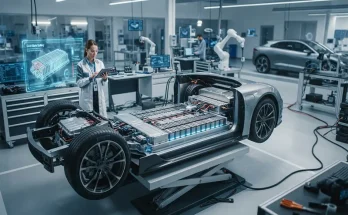
Electric vehicles serve as the ideal native host for high-performance AI compute. Unlike legacy internal combustion engine (ICE) platforms, battery-electric architectures feature stable, high-voltage power supplies capable of handling massive computational loads, alongside precise, millisecond-level torque vectoring and brake-by-wire mechanics required for safe autonomous execution.
Core AI Advancements Driving Modern Autonomous EVs
The rapid scaling of the broader AI ecosystem has dismantled years of technological bottlenecks, introducing breakthroughs that redefine how cars navigate the physical world:
1. Vision-Language-Action (VLA) Models and End-to-End Neural Networks
Traditional autonomous driving relied heavily on rigid, human-coded rulebooks that often faltered in chaotic or edge-case environments. Today, the industry has transitioned toward End-to-End Deep Learning and Vision-Language-Action (VLA) frameworks.
- Semantic Reasoning: VLA models integrate visual perception, contextual reasoning, and action planning into a unified neural architecture.
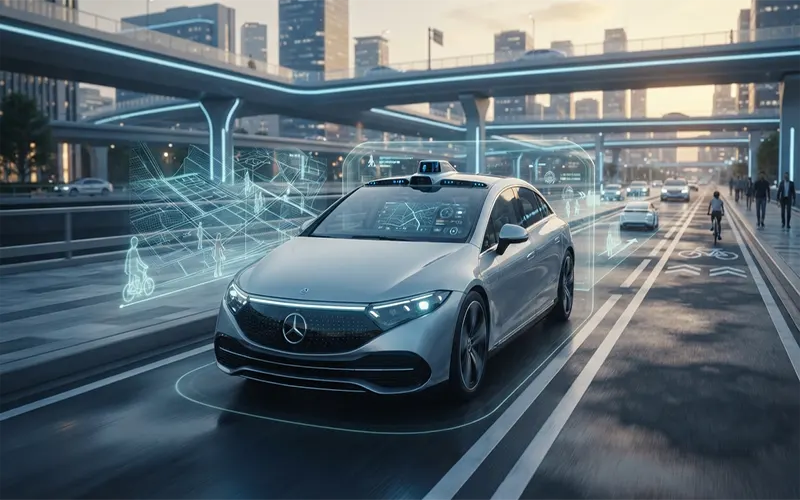
- Human-Like Adaptability: Rather than simply detecting obstacles, cars can now reason semantically about complex or unusual situations—such as interpreting erratic pedestrian behavior, construction detour hand-signals, or unusual roadside debris—and execute smooth, human-like maneuvers in real time.
2. High-Performance Domain Compute and Sensor Fusion
Autonomous intelligence requires staggering amounts of computational power at the edge. Modern smart EVs deploy massive domain controllers delivering thousands of TOPS (Tera Operations Per Second) to process incoming sensory streams.
- World Models: Multi-camera arrays, 4D imaging radars, and high-resolution solid-state LiDAR systems work in concert to construct dense, real-time 3D world models.
- Cost-Performance Balance: As the unit economics of solid-state LiDAR and advanced high-throughput chips stabilize, luxury-tier perception capabilities are rapidly trickling down into mass-market consumer EVs.
3. Scalable Simulation and Physical AI Training
Training autonomous models to handle millions of rare scenarios safely cannot be achieved purely on public roads.
- Generative Simulation: Developers now utilize cloud-based digital twins and generative AI simulation platforms (such as NVIDIA’s Alpamayo ecosystem) to feed trillions of synthetic and real-world miles into training pipelines.
- Continuous Reinforcement Learning: Fleets continuously learn from edge cases encountered globally, pushing over-the-air (OTA) updates that drastically shorten the timeline for deploying complex autonomous functions.
The Synergistic Loop: Why EVs and Autonomy Belong Together
The hardware harmony between battery-electric platforms and artificial intelligence creates an unmatched performance loop. EVs possess inherently lower mechanical complexity than combustion vehicles, featuring fewer moving parts and immediate electronic responsiveness.
When an AI pilot detects a hazard, the conversion of digital intent to physical action—via digital steering actuators and precise electronic torque distribution—occurs exponentially faster than traditional mechanical linkages allow. This hardware-software integration provides the exact physical precision needed for safe, high-speed autonomous execution.
Crossing the Chasm: From Advanced ADAS to Commercial L3 and L4 Fleets
The deployment spectrum of autonomy is expanding rapidly across two distinct fronts:
- Consumer-Facing L2+ and Conditional L3: Mass-market vehicles heavily feature advanced driver assistance systems (ADAS) equipped with Navigation on Autopilot (NOA) for highways and dense urban centers. Conditional Level 3 systems are progressively gaining regulatory clearance, allowing drivers safely to disengage from continuous monitoring under specific operational conditions.
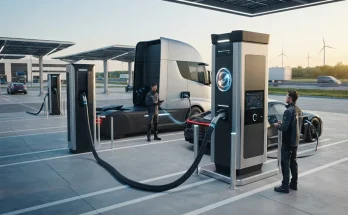
- Commercial Level 4 Fleets: Robotaxi and logistics networks are spearheading full commercialization. Standardized computing and sensor frameworks are enabling rideshare platforms and autonomous trucking providers to scale driverless operations across major metropolitan areas worldwide.
The convergence of artificial intelligence and electric vehicles has fundamentally transformed the automobile from a mechanical commodity into a self-improving robotic platform. By harnessing advanced VLA models, massive edge compute, and native electrical architecture, the mobility sector is laying the groundwork for an era where transportation is safer, cleaner, and entirely autonomous.