
1. The Holy Grail of Energy Storage
For over a decade, solid-state batteries (SSBs) have been heralded as the ultimate “holy grail” of the electric vehicle (EV) industry. Traditional lithium-ion cells, while reliable, are reaching a physical ceiling regarding energy density, charging speed, and inherent thermal safety risks due to their volatile liquid organic electrolytes.
Replacing those flammable liquids with solid materials—such as ceramics, polymers, or sulfides—fundamentally rewrites the rules of electrochemical energy storage. As the automotive sector navigates manufacturing scaling and regulatory milestones, the transition from laboratory prototypes to real-world, road-going production is shifting from speculative theory to industrial reality.
2. The Mechanics: How Solid-State Batteries Work
To understand why solid-state technology is revolutionary, look closely at the interior architecture of a standard battery cell:
- Traditional Li-Ion: A porous separator soaked in liquid organic solvents carries lithium ions back and forth between the cathode and anode. While functional, this liquid “juice” is prone to degradation, pressure swelling, and flash fires under thermal runaway conditions.
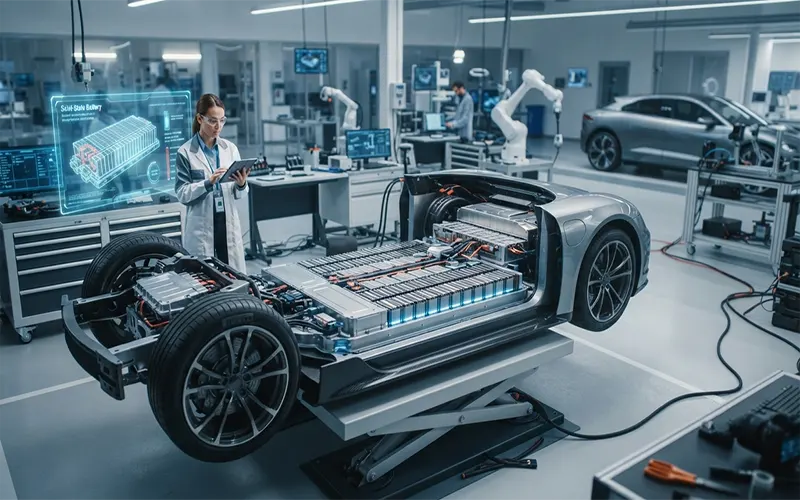
- Solid-State Architecture: The liquid electrolyte is entirely or partially replaced with a solid ion-conductive matrix.
This structural swap yields profound technical advantages:
- Eliminating Volatility: Without flammable solvents, the risk of catastrophic fire during a crash or thermal runaway event drops toward zero.
- Soaring Energy Density: By enabling safer structural designs and high-capacity components, solid-state systems target energy densities of 350 to 500+ Wh/kg (compared to conventional 200–260 Wh/kg cells).
- Climate Resilience: Solid-state cells maintain superior ionic conductivity in extreme environments, suffering far less capacity loss during sub-zero winter operations.
3. Current Landscape: Semi-Solid vs. All-Solid-State Realities
The commercialization timeline requires a clear distinction between two parallel tracks currently hitting the market: semi-solid and all-solid-state systems.
- The Semi-Solid Bridge: Bridging the gap between legacy liquid cells and future tech, semi-solid batteries retain a small percentage (roughly 5% to 15%) of liquid or gel electrolyte. Because they integrate smoothly with existing lithium-ion gigafactory production lines, manufacturers have successfully accelerated their rollout.
- All-Solid-State Milestones: True all-solid-state cells—featuring zero liquid components—are transitioning from advanced pilot lines toward early vehicle integration. Global automakers and advanced energy firms (such as Dongfeng, CATL, and Toyota) are racing to validate these packs. For instance, automotive roadmaps highlight oxide-polymer composite routes and advanced sulfide systems designed to achieve robust mass-market viability.
Regulatory frameworks are also adapting; formal classification standards—such as specialized guidelines distinguishing all-solid from semi-solid architectures—are entering force to establish consumer transparency and engineering clarity.
4. Overcoming Engineering Hurdles
Despite profound progress, scaling solid-state chemistry involves solving complex microscopic engineering bottlenecks:
- The Solid-Solid Interface Challenge: In traditional liquid cells, liquid naturally “wets” the electrode surfaces uniformly. In a solid-state cell, two rigid solids only touch at microscopic contact points, creating high internal electrical resistance. Researchers are actively deploying ultra-thin buffer layers, nanoscale coatings, and elastic composite interlayers to maximize surface contact.
- Dendrite Growth and Mitigation: High-performance lithium metal anodes are prone to developing microscopic, needle-like metallic structures called “dendrites” during rapid charging. If left unmitigated, these dendrites can pierce the solid electrolyte and cause an internal short circuit. Advanced ceramic microstructures and multi-particle sizing are increasingly utilized to block dendrite propagation.
- Manufacturing Ecosystems: Certain promising electrolytes (like sulfides) are highly moisture-sensitive and require strict, costly dry-room manufacturing environments to prevent the release of unwanted hydrogen sulfide gas. Overcoming these scaling hurdles remains critical to achieving true cost parity with legacy lithium-ion options.
5. Real-World Impact: What This Means for EV Owners
When solid-state and advanced semi-solid packs scale into consumer vehicles, the driving experience changes fundamentally:
- The 1,000-Kilometer Horizon: With energy densities pushing past 350 to 500 Wh/kg, standard passenger cars can comfortably surpass a 1,000 km (620+ miles) range on a single charge, effectively eliminating long-distance range anxiety.
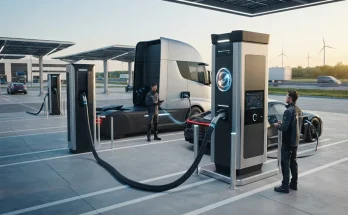
- Lightning-Fast Replenishment: Because solid electrolytes tolerate high current loads without destabilizing, drivers can experience rapid high-power charging sessions—recovering massive chunks of range in mere minutes.
- Cabin and Chassis Freedom: Lighter, smaller battery packs require less structural safety buffering. This frees up interior cabin volume, enhances vehicle aerodynamics, and allows engineers to rethink overall vehicle weight distribution.
The evolution of solid-state battery technology represents a monumental shift for modern transportation. While distinctions between semi-solid commercial rollouts and long-term all-solid-state maturation require careful industry navigation, the trajectory is clear.
As manufacturing yields improve, costs decline, and engineering hurdles are systematically cleared, solid-state advancements are poised to permanently close the gap between electric mobility and internal combustion convenience—ushering in an era of hyper-safe, ultra-long-range sustainable transport.